29th January 2026
//
Case Studies//
Do we really need that many tip boxes? How a simple question can lead to greener omics
Organisation: EMBL
Authors: Marta Rodríguez-Martínez
The omics era, marked by the rapid advancement of high-throughput technologies, has revolutionised the field of molecular biology, propelling forward our understanding of biological systems. This scientific revolution has opened up new avenues for human health and environmental conservation. However, it is crucial to recognise the impact it has on environmental sustainability. To put it simply, Omics research uses a lot of ‘stuff’. Together with the generation of vast amounts of data and the ever-increasing demand for computing power, the manufacturing, disposal, and maintenance of equipment and resources used in omics significantly contribute to environmental degradation.
To harness the benefits of the omics era while mitigating its negative impact on the environment, researchers and suppliers must work together. EMBL’s core facilities, scientists and suppliers have collaborated to address waste generation during omics research, specifically in library preparation and related processes. Their approach focuses on optimising protocols and embracing eco-friendly techniques and equipment to minimise their environmental impact.
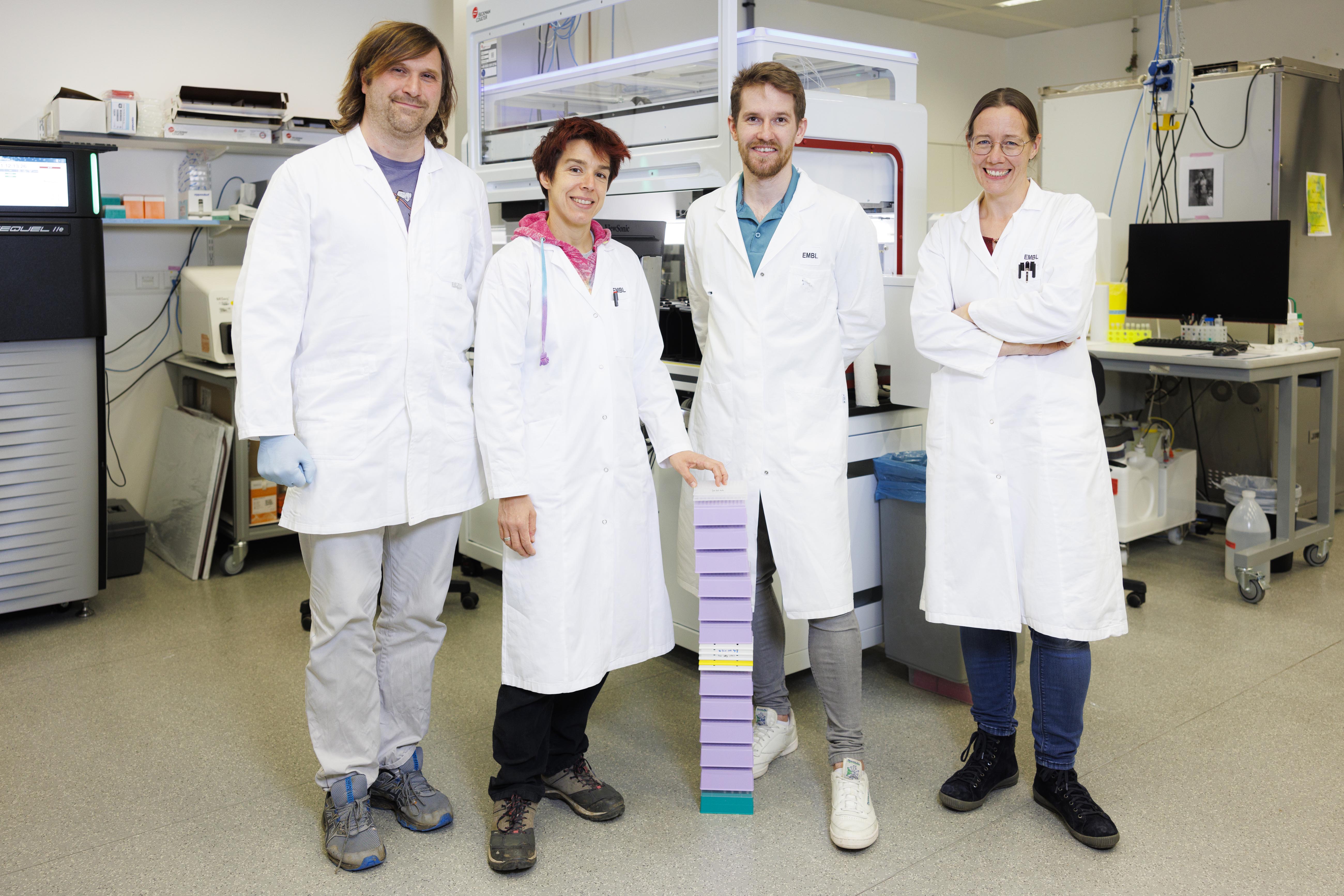
Scientists from EMBL'S Korbel lab and GeneCore facility have managed to more than halve the number of pipette tips – and their corresponding plastic boxes – and multiwell plates necessary for an efficient and reproducible single-cell DNA template strand sequencing (Strand-seq) protocol. For the success of this method, the researchers optimised the number of steps needed to get a high-quality and pure sample, especially by cleaning the sample only when it is necessary rather than at every step of the sample preparation.
In addition to the scientists’ efforts, novel liquid-handling technologies and automation have been integrated into the routine work of EMBL facilities. These help with precisely dispensing reagents and samples, eliminating the need for excessive manual pipetting and integrating the wash and reuse of pipette tips.
These changes have also led to an increase in the versatility of the method, making possible the combination of Strand-Seq with RNA-seq. This new approach is not only more environmentally friendly and more efficient but also helps to save a great amount of money.
Before making this change producing one Strand-seq library required 27 tip boxes and 13 hard plastic plates. With the newly developed protocol, this amount has been reduced to 12 boxes and 5 plates!
These methods not only reduce plastic waste but also enhance the reproducibility and efficiency of library preparation, once again demonstrating that sustainability and quality science go hand in hand. As a result, the scientific community is driving positive change by embracing sustainable practices, fostering a greener future for molecular biology and environmental sustainability.
This change was only possible with the assistance of the pipetting robot manufacturer Beckmann and their help in setting up this new pipeline.
These kinds of changes require not only a great amount of work and the highest expertise but also tremendous courage. Changing a process that works, in order to make it more environmentally friendly, is not something one sees every day in the scientific world.